Seattle Family Calendar
 Subscribe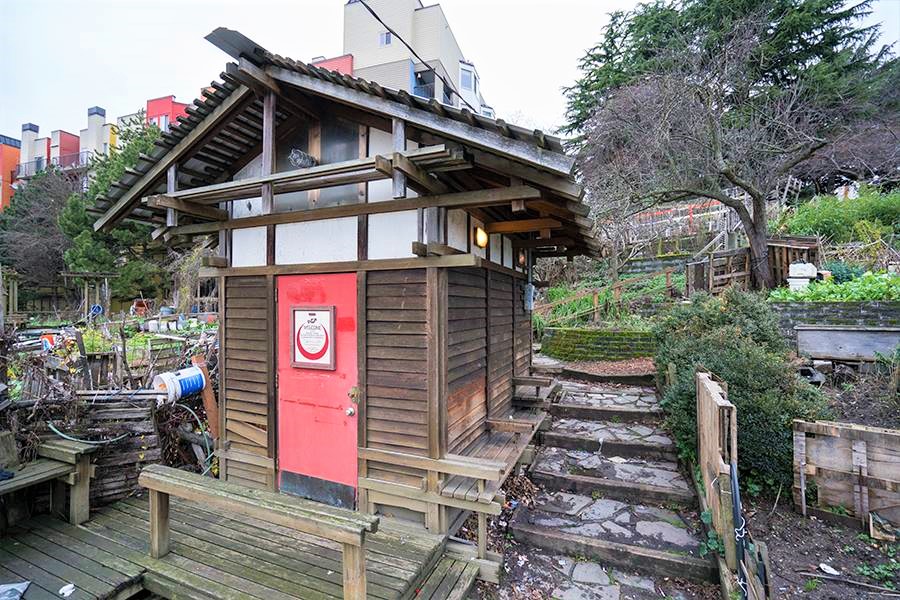

Unique gardens to explore around Seattle and beyond
Want a new spot for enjoying some nature renewal with your family? We’ve unearthed 12 wonderful, lesser-known gardens around Puget Sound, each of which has something special to offer kids and families. There’s a garden designed to teach lessons about honeybees, a pocket park that’s also a cosmological adventure, and a garden where community gardeners keep their traditions alive.
Click the arrows above the image or the link below to follow the path to some of the Seattle area’s coolest gardens.
First stop: The bees, please
West Seattle Bee Garden

The West Seattle Bee Garden is a must-visit destination if your kids are curious about honeybees, especially if you want to observe the buzzers from a safe distance. The centerpiece of the park is two hives nestled within an enclosure. The enclosure is covered in hexagonal panels that display fascinating bee facts.
This honeycomb-style structure is located in a community P-Patch garden, adjacent to a playground and a large community green space. Be sure to take the short walk a few blocks away to Southwest Raymond Street and 31st Avenue Southwest where Viewpoint Park affords an amazing panorama of the Seattle skyline.
Location: High Point Commons Park, S.W. Graham Street, Seattle
Next stop: Peak park
Fremont Peak Park, Seattle

When I’m working in my garden in the summer, there’s a big old mystery that I have always wanted to understand: Exactly how far south and north does the angle of the sun change as it moves across the sky seasonally?
To my surprise, I found the answer perfectly presented in a visual format at Fremont Peak Park, a small park located in North Seattle about 10 blocks from Woodland Park Zoo. There it was, a sculptural Y embedded in the view terrace, with legs pointing to the locations of the sunset at the winter and summer solstices.
Entering the park sets visitors on a mythological and cosmological adventure. You will be encouraged to travel through a labyrinth, and, by its end, blooming roses, tall trees and a view of the Olympic Mountains reward you. Now I understand why Fremont Peak Park was recognized as one of the 45 best public art projects in the United States at the 2008 Americans for the Arts annual convention.
Location: 4357 Palatine Ave. N., Seattle
Next stop: Danny Woo
Danny Woo Community Garden, Seattle

Wandering through the Danny Woo Community Garden in Seattle’s Chinatown–International District reveals many levels of terraced gardens. Gardeners here, some of them immigrants from Asian countries, tend their plots lovingly, with each person’s area marked with elaborate fence fixtures. While winding along these secret paths, you may encounter gardeners who are friendly and welcoming. At the height of the season, you may be invited to try a veggie you’ve never seen before.
The impressive children’s garden here reminds me that this multigenerational gardening effort, happening right next to the freeway within a small urban space, makes a powerful statement about the importance of homegrown food.
The Danny Woo garden is part of Kobe Terrace Park.
Location: 650 South Main St., Seattle
Next stop: O.G. p-patch
Picardo P-Patch Children’s Garden, Seattle

Have you ever wondered how Seattle’s network of community gardens — called the P-Patch Community Gardening Program — got started? If so, you must visit the original P-Patch Picardo Farm, located in northeast Seattle’s Wedgwood neighborhood.
Fifty years ago, a group of neighborhood activists and a Seattle City Council member helped develop a program to let fallow farmland in the city remain farmland. The P-Patch Community Gardening Program was born, with the “P” commemorating the Picardo family, whose farm became Seattle’s very first P-Patch.
Picardo was the first of 89 smaller gardens that have bloomed since then, sprinkled throughout Seattle’s neighborhoods. Picardo Farm covers an expansive 98,000 square feet. In the southeast corner of the garden, you’ll find the children’s garden, which features several wonderful components, including an immense climbing-bean teepee.
Location: 8040 25th Ave. N.E., Seattle
Next stop: A magical garden
Kruckeberg Botanic Garden, Shoreline

I have never been to a more welcoming garden for children than Kruckeberg Botanic Garden in Shoreline.
Taking an enchanting self-guided tour, my children thoroughly enjoyed finding treasures throughout the garden, as I was learning about the plants and trees. Hidden in the woods a stunning driftwood climbing structure captivated all of us.
This intimate garden is like an exceptional backyard collection of exotic and rare plants suited to our Northwest climate. However, each of these plants is labeled and available for purchase in the nursery, which is why my daughter describes the garden as “a plant store with a big park in the back.” Simply stated, yet it’s delightfully true.
Kruckeberg Botanic Garden is open to the public Friday–Sunday, 10 a.m.–5 p.m., March through October. (The garden stays open 10 a.m.–3 p.m. November–mid-February.)
Location: 20312 15th Ave. N.W., Shoreline
Next stop: The Highline
Highline SeaTac Botanical Garden

The heart of Highline SeaTac Botanical Garden is Elda Behm’s Paradise Garden. Elda Behm was an award-winning landscape designer, horticulturist and flower arranger. Her original garden was condemned to make way for the Port of Seattle’s third runway expansion at Sea-Tac International Airport. Fortunately, it was saved and re-created by relocating thousands of Behm’s plants (which she had grown from seeds and cuttings) to the new Highline SeaTac Botanical Garden.
Within this paradise you will find a series of water features, including ponds and waterfalls that empty into a 100-foot stream. If you visit the garden in spring, you’ll see large bearded irises and rhododendrons in full bloom.
Location: 13735 24th Ave. S., SeaTac
Next stop: Hilltop gem
Seattle Chinese Garden, West Seattle

Often called the best-kept secret of West Seattle, the Seattle Chinese Garden’s spectacular landscape has been created using elements of water, stone, plants and architecture.
Within this beautiful garden on a hilltop, families will find themselves surrounded by ancient symbolism. The bones of the earth are depicted by stone bridges and rocky gorges. The blood of the earth is suggested by water, which infuses the garden with vital, rejuvenating qi.
Upon entry, pick up a self-guided-tour brochure and plant guide to inform your visit. South Seattle College’s campus arboretum, adjacent to the Chinese garden, and is free and open to the public.
Location: Approximately 5640 16th Ave. S.W., Seattle
Next stop: Bridges and waterfalls
Kubota Garden, Seattle

Kubota Garden located near Rainier Beach, is an enchanting 20-acre Japanese garden that was designated a historic city landmark in 1981. So it’s not quite the secret garden it once was, and is now counted as a favorite backdrop for family photos.
But there are still some days when you can have the lovely winding paths, ponds, waterfalls and hidden red bridges all to yourself. Kids are almost magically pulled along by the paths that slope downhill from the entrance, and the garden is just big enough that they’ll feel like they’re getting a little lost. It’s delightful in all seasons, offering blooms in spring, shade in summer, color in fall and opportunities to skitter rocks across icy ponds in winter.
Location: 9817 55th Ave. S., Seattle
Next stop: City farm
Kelsey Creek Farm, Bellevue

If your child needs a dose of farm animal fun mixed in with your garden explorations, then Kelsey Creek Farm Park in Bellevue is the place to visit. While not exactly secret, this spot is a quiet and secluded home to ponies, sheep, goats, chickens, pigs and other critters.
Dating from the 1930s, this historic farm hosts a number of excellent programs for kids and families, including recreational opportunities, seasonal camps, farm experience classes, tours and volunteer opportunities. The barnyard and playground are open daily, 9 a.m.–3 p.m.
Location: 410 130 Pl. S.E., Bellevue
Next stop: Botanical bounty
Bellevue Botanical Garden

While Bellevue Botanical Garden is also not particularly secret, its 20 acres of paths and innovative gardens make an ideal first hike for a preschooler, from its Lost Meadow Trail through wetlands and woodlands to a rock garden to the ultimate adventure for the short set: a one-third-mile-long nature trail that crosses a ravine via a 150-foot suspension bridge. Don’t miss a meditative walk through Yao Garden.
Location: 12001 Main St., Bellevue
Next stop: Hedge heaven
PowellsWood, Federal Way

PowellsWood is a place to go to see the hedges. As funny as that sounds, I was quite intrigued by the beautiful meld of fern and rhododendron borders adjacent to conifer forest.
Unlike most of the garden destinations on this list, PowellsWood is a private garden requiring paid admission or membership ($30 for an individual membership; $45 for a family membership). It’s a lovely garden featuring various scenes and landscapes to explore in all seasons.
The garden is open to the public Tuesday–Saturday, 10 a.m.–3 p.m. Adult admission is $7; kids ages 12 and younger enter free.
Location: 430 S. Dash Point Rd., Federal Way
Next stop: Garden oasis
Lakewold Gardens, Lakewood

Though this is another garden requiring paid admission, lovely Lakewold Gardens still warrants a visit. It’s a peaceful and beautiful oasis that will certainly leave you feeling calm and serene. It’s a great setting for kids to explore and discover fascinating plants, but it isn’t the place to bust out your Nerf football or play a game of screaming hide-and-seek.
The garden is open Wednesday–Sunday, 11 a.m.–5 p.m. Buy tickets online in advance. General admission is $12 for adults and $6 for children ages 6–17; kids ages 5 and younger enter free.
Location: 12317 Gravelly Lake Dr. S.W., Lakewood

Bonus: Alki Flower Houses
While not technically a garden, the famous Alki Flower Houses, built in 1914, have been an eye-popping tourist draw on the West Seattle beachfront strand for decades. Owner Randie Stone purchased them in 1989 after moving from Hawaii, and the islands were her inspiration when she planted her homes’ profusion of blooms. Other standout features include a public water fountain and a driftwood swing.
Now officially registered as a wildlife habitat by the National Wildlife Federation, the Flower Houses also attract all manner of pollinator pals.
Location: 1400 Alki Ave. S.W., Seattle
More Puget Sound-area nature fun with kids
Editor’s note: This article was originally published several years ago and updated most recently for 2023.